
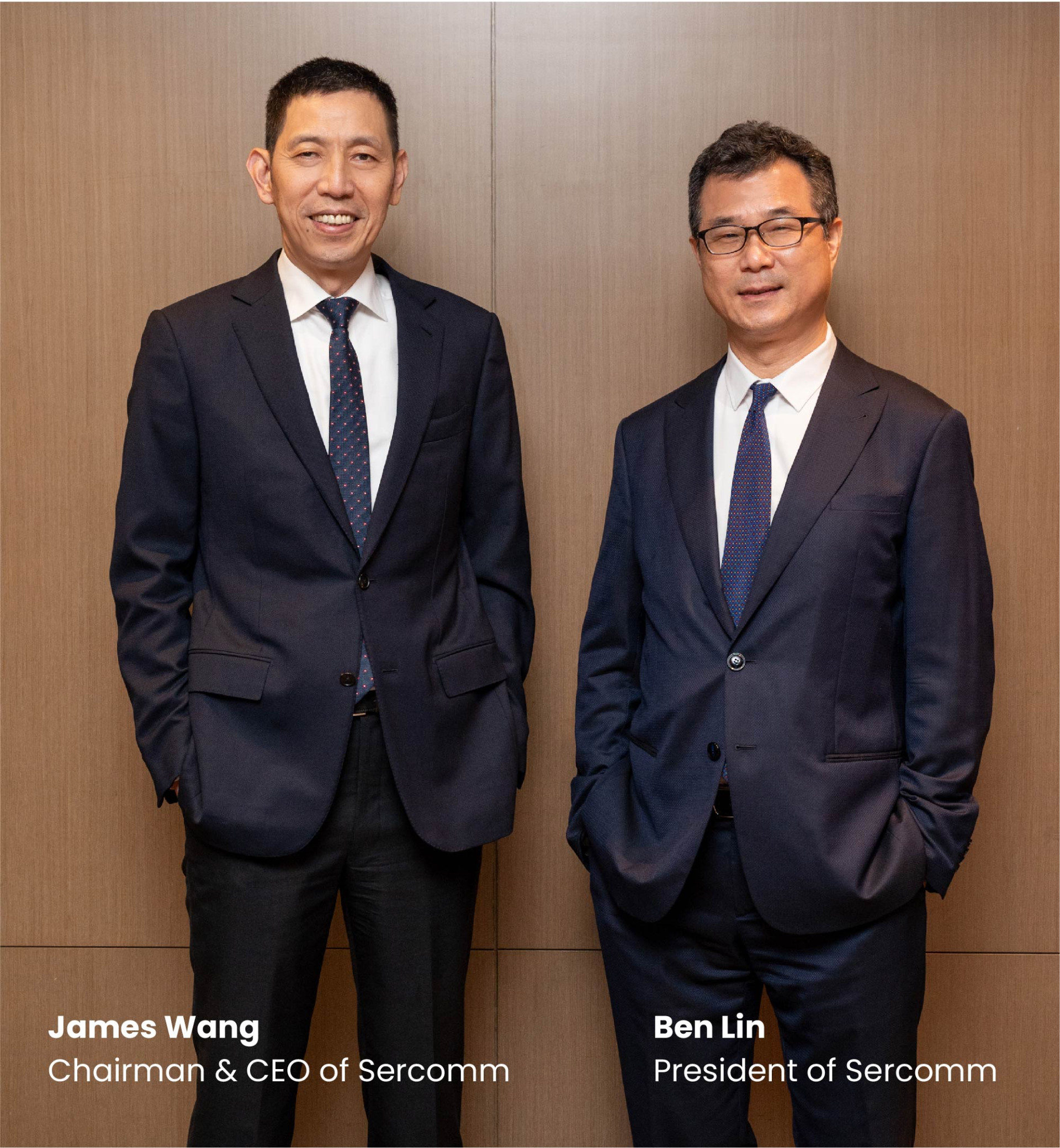
In 2025, the networking industry faced exchange-rate volatility, U.S. tariffs and rising component costs. Sercomm continued to invest in R&D and pursue prudent market strategies. As customer inventories normalized and demand recovered, shipments of next-generation broadband products gained momentum. Consolidated revenue reached NT$54 billion, with a gross margin of 15.7% and EPS of NT$4.04.
We strengthened coordination across five manufacturing centers in Chunan, Suzhou, Calamba, New Delhi and Mexico. Our second Philippine facility began mass production, with further expansion planned in Mexico. We also continued to develop markets in Southeast Asia, Latin America and the Middle East.
Sercomm continued its ESG efforts and low-carbon transition. We ranked in the top 6%–20% of Taiwan's Corporate Governance Evaluation and earned the EcoVadis Platinum Medal, placing us in the global top 1%.
In 2026, we will continue developing Wi-Fi 7, 5G FWA, enterprise networking, AI-powered IoT and distributed access products. Through innovation, cost discipline and closer customer partnerships, we aim to create long-term value for shareholders, customers and employees.
To address stakeholder expectations and establish a consistent path for sustainability initiatives across environmental, social, and governance dimensions, Sercomm reviews and adjusts its sustainability strategy based on the core principles of the United Nations Sustainable Development Goals (SDGs), identified sustainability risks and opportunities, and the results of its annual material topic assessment.
Together, these elements form a unified framework that guides sustainability action plans and the setting of short-, medium-, and long-term goals.

Sercomm incorporates the Responsible Business Alliance (RBA) Code of Conduct and international standards such as ISO into its responsible operations framework. Based on the nature of each site’s operations, the Company maintains management and verification mechanisms covering quality, occupational health and safety, environment, energy, greenhouse gas inventories, information security, and supply chain security. Implementation is reviewed through self-assessments, internal audits, third-party certification or verification, and management review, with corrective actions tracked to improve management effectiveness.
Identify applicable regulations, customer requirements, and international standards, and incorporate them into management policies and systems.
Responsible units implement training, risk controls, and routine management activities in accordance with established procedures.
Review implementation and effectiveness through self-assessments, internal and external audits, and third-party certification or verification.
Track audit findings and corrective actions, and update management objectives and practices through management reviews.
For the scope of management system certifications and the certification bodies for each site, please refer to page 127 of the Sercomm 2025 Sustainability Report.
Sercomm integrates climate change into its corporate governance and enterprise risk management. The Board of Directors is the highest oversight body for climate governance and oversees the management framework, strategic direction, and targets for climate-related risks and opportunities. Chaired by the President, the Sustainable Development Committee meets quarterly to review climate risk assessments, SBTi targets, and related action plans, and periodically reports implementation progress to the Board.

Sercomm participates in CDP assessments and discloses its GHG emissions, climate risks, and management responses. Assessment results are used to review data quality and disclosure gaps.
Sercomm applies the TCFD pillars of governance, strategy, risk management, and metrics and targets to integrate climate issues into enterprise risk management and progressively align with IFRS S2.
Sercomm's SBTi targets were validated in 2025. From a 2023 base year, the Company targets a 42% reduction in absolute Scope 1 and Scope 2 emissions and a 25% reduction in Scope 3 emissions by 2030.
In 2025, the Sustainable Development Committee reviewed and tracked SBTi target and scenario modeling, internal carbon pricing planning, Scope 3 tracking and supply chain decarbonization, renewable energy and energy management, and customer product life cycle assessment and product carbon footprint methodologies. Regular reporting and follow-up connect climate strategy with business operations and customer needs.
For detailed climate risks and opportunities, scenario analysis, metrics, targets, and performance, see Environment & Innovation.

Under its Sustainable Procurement Policy and Supplier Management Procedure, Sercomm integrates environmental protection, occupational health and safety, labor and human rights, business ethics, information security, and personal data protection into supplier management. Suppliers are required to comply with applicable laws, the Responsible Business Alliance (RBA) Code of Conduct, and green product requirements including RoHS, REACH, and WEEE. Sercomm manages environmental and social risks through supplier commitments, risk assessments, audits, and corrective action follow-up.
Supplier due diligence follows the OECD guidance and the RMI's CMRT and EMRT. Sercomm reviews mineral origins and smelter qualification status, and requires a phase-out plan when an unqualified smelter is identified.
Guided by ISO 20400, procurement decisions consider environmental and social factors. Sercomm prioritizes environmentally preferable, low-carbon, low-hazard, and recyclable materials, and encourages suppliers to establish environmental and energy management systems.
No suppliers were identified as having significant actual or potential negative environmental or social impacts in 2025. For the complete management system, audit scope, and performance data, see pages 30-37 of the Sercomm 2025 Sustainability Report.
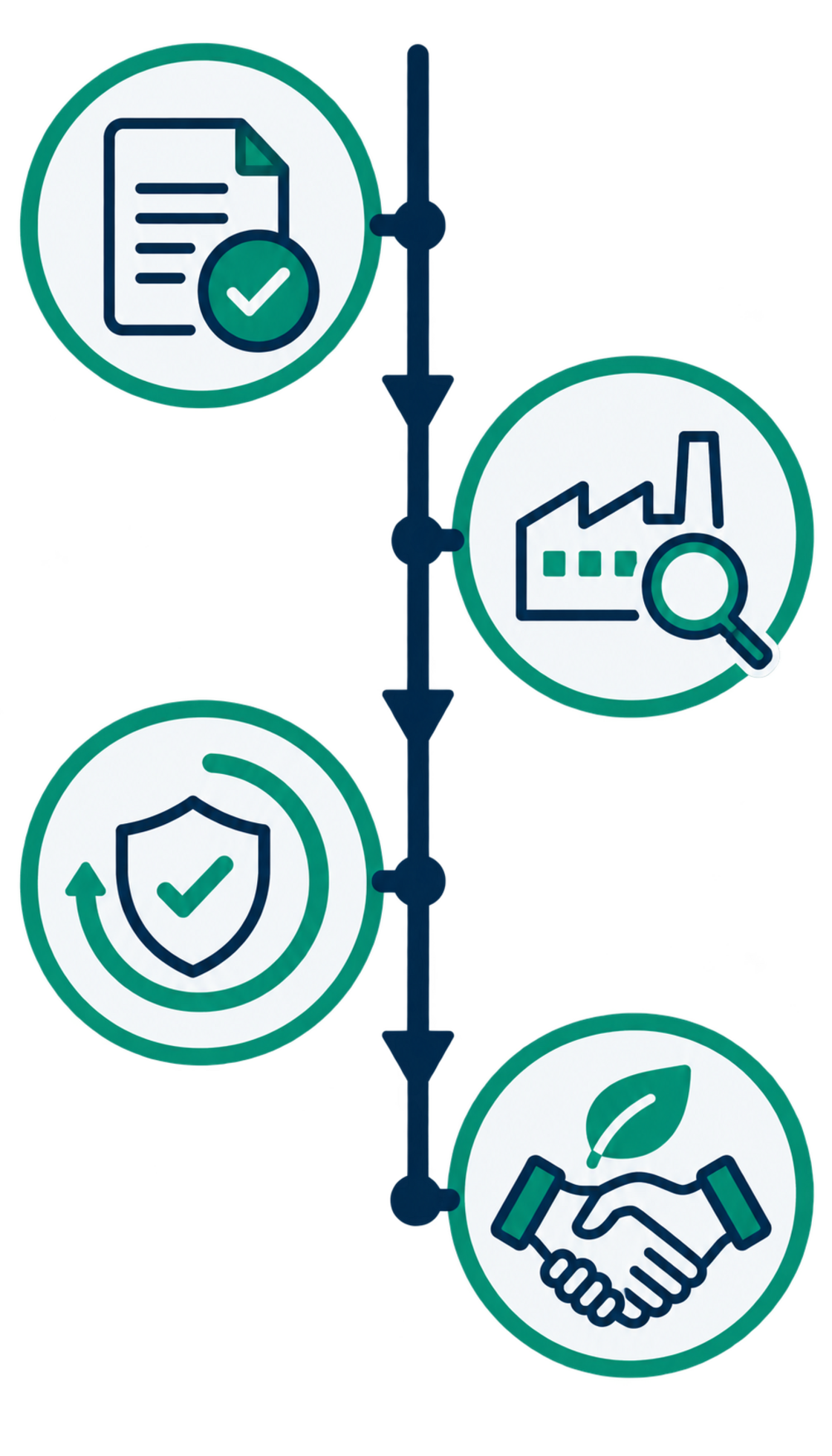
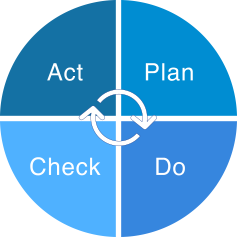
Sercomm regards information security as essential to operational resilience and to protecting corporate, customer, and product information. Guided by its Information Security Policy and ISO/IEC 27001:2022 Information Security Management System (ISMS), the Company applies governance oversight, risk assessment, security controls, monitoring and audits, incident response, and continual improvement through the PDCA cycle. Privacy and personal data protection are managed as a related but distinct area covering the lawful use and security of personal data throughout its life cycle.
Sercomm regularly conducts information asset inventories, risk assessments, vulnerability scans, and penetration tests. Intrusion detection, network access control, endpoint detection and response, and encryption of confidential information strengthen the security of networks, devices, applications, and data. Twenty-four-hour monitoring, tiered incident reporting, disaster recovery, social engineering, and breach-and-attack simulation exercises further enhance detection and response capabilities.
The Product Security Incident Response Team (PSIRT) integrates the Secure Development Lifecycle (SDLC) into product design, development, verification, and post-launch management. Products are tested for malware, backdoors, network vulnerabilities, and potential attacks, with identified issues tracked through JIRA. Researchers, industry organizations, and suppliers may report a product vulnerability, including the affected product and version, issue details, and exploitation status, to PSIRT@sercomm.com.
Sercomm incorporates privacy and personal data protection requirements for employees, suppliers, customers, and consumers into its Sustainable Development Best Practice Principles, Employee Handbook, Supplier's Code of Conduct Agreement, Information Security Management Manual, and other management documents. These requirements apply across branches, operating sites, and subsidiaries. In accordance with the Personal Data Protection Act and applicable requirements, the Company applies controls to the collection, storage, processing, transmission, and sharing of personal data. Confidentiality agreements, access controls, system and equipment safeguards, and training further protect employee and customer data.
For the complete governance structure, management mechanisms, incident reporting process, exercises, and secure product development process, please refer to pages 111-114 of the Sercomm 2025 Sustainability Report.
Sercomm turns review findings and incident lessons into corrective actions and management updates.
- Management reviews assess KPIs, risk changes, audits, incidents, and resource needs.
- Assign owners and deadlines for deficiencies, then verify corrective action effectiveness.
- Apply incident lessons to improve reporting, response, recovery, and security awareness training.
- Update policies, procedures, risk treatments, and controls for regulatory, threat, technology, or business changes.
- Track improvements through governance reporting until effective closure.
Sercomm plans its information security management in line with its policy, ISO/IEC 27001:2022, and applicable requirements.
- Set annual objectives, KPIs, and action plans based on operational, regulatory, customer, and contractual needs.
- Inventory information assets, assess impacts, threats, and vulnerabilities, and define risk treatment.
- Assign responsibilities and reporting lines across governance and implementation teams.
- Define incident levels, reporting timelines, response and recovery goals, including privacy and personal data protection.
Sercomm reviews control effectiveness and performance through monitoring, testing, exercises, and audits.
- Use endpoint detection and the security operations center for 24-hour monitoring and incident tracking.
- Scan vulnerabilities, update information asset inventories, and perform business impact analysis.
- Conduct penetration tests and BAS exercises to validate detection and response.
- Perform internal audits, management reviews, and third-party audits against ISO/IEC 27001:2022.
- Review KPIs, incidents, exercises, and findings, then track corrective actions and report results.
Sercomm implements risk treatment plans across people, systems, data, and suppliers.
- Manage accounts, authentication, and system access by job requirements, with regular permission reviews.
- Protect confidential, customer, and personal data through classification, encryption, backup, and secure handling.
- Provide onboarding, security awareness training, and social engineering exercises.
- Apply security requirements and periodic assessments to IT contractors and suppliers.
- Classify and report incidents, then respond, recover, and track improvements under established procedures.
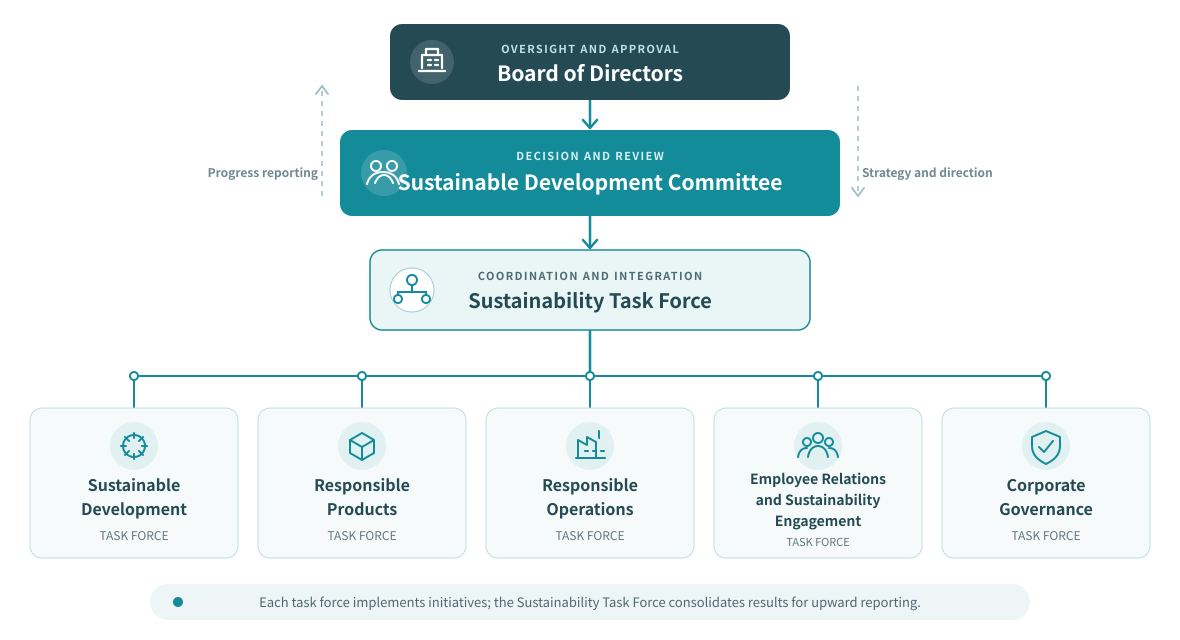
Sercomm links Board oversight with management decisions and cross-functional execution through a four-level sustainability governance structure.
Board of Directors|Oversight and Approval
Approves and oversees Sercomm's sustainability vision, strategy, and direction. The Committee reports key progress and issues to the Board at least annually.
Sustainable Development Committee|Decision and Review
Chaired by the President and composed of directors and senior executives, the Committee reviews policies, strategies, targets, action plans, and performance. It meets quarterly and held four meetings in 2025 with 100% attendance.
Sustainability Task Force|Coordination and Integration
Coordinates sustainability plans and responsibilities, consolidates targets, annual actions, and results each month, and reports to the Committee. Written updates are provided in months without an in-person meeting.
Five Thematic Task Forces|Implementation
Sustainable Development, Responsible Products, Responsible Operations, Employee Relations and Sustainability Engagement, and Corporate Governance set targets and action plans, implement initiatives, and report progress as required.
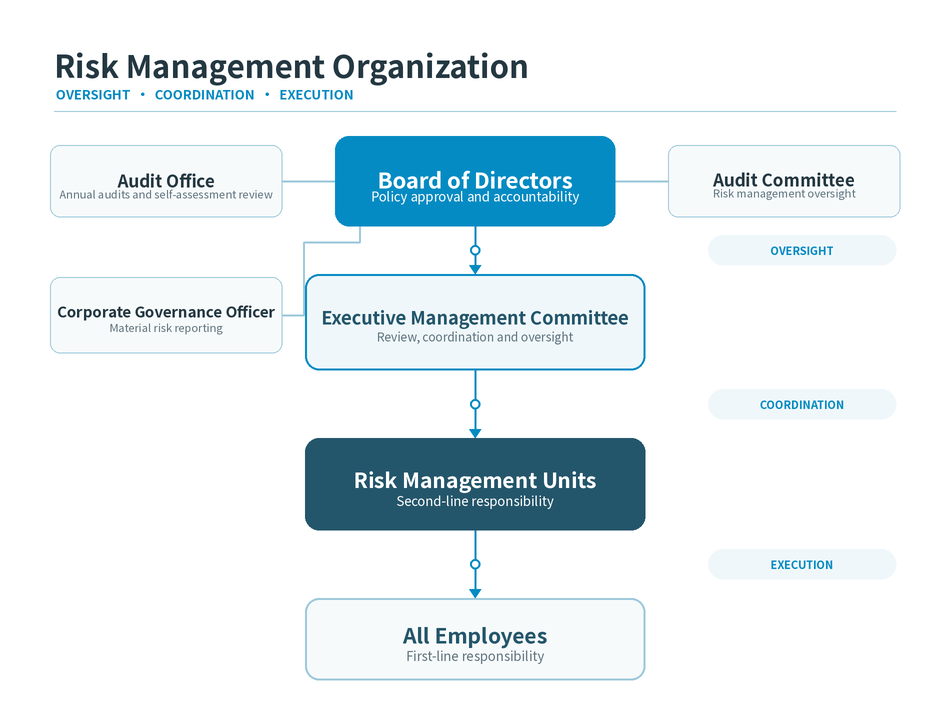
Approved by the Board in 2020, Sercomm's Risk Management Policies and Procedures guide enterprise risk management.
Governance
The Board holds ultimate accountability, supported by the Audit Committee and Executive Management Committee. Risk units implement controls. The Audit Office reviews self-assessments and corrective actions.
Process
Following ISO 31000, Sercomm manages risks through identification, analysis, assessment, response, and tracking, with regular reporting and monitoring.
Risk Scope
Assessments cover strategic, operational, financial, and event risks, including supply chains, information security, intellectual property, customer credit, climate change, and occupational safety. Material risks are reported to the Board with response plans and targets.
Business Continuity
Business Impact Analysis identifies critical processes and recovery priorities. At least one test or drill is conducted annually, and continuity plans are updated as needed.
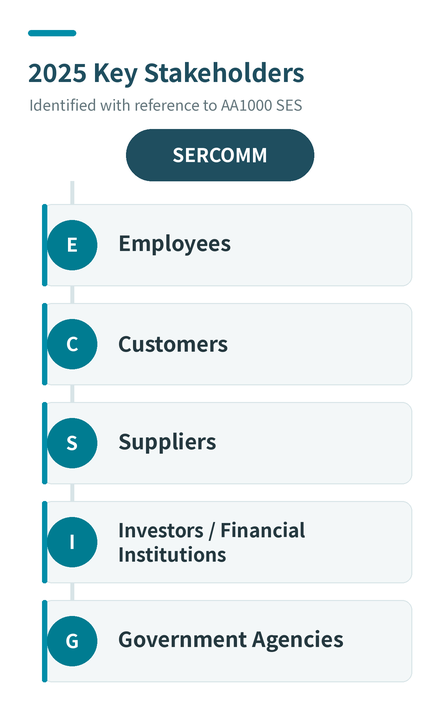
Sercomm identifies key stakeholders with reference to the AA1000 Stakeholder Engagement Standard 2015 (AA1000 SES), its industry context, and operating characteristics. The 2025 assessment identified five groups: employees, customers, suppliers, investors/financial institutions, and government agencies.
Identification and Governance
The assessment considers operational interaction, issue impact, and communication frequency. External expert input on industry trends, regulatory requirements, and stakeholder expectations is also incorporated to support a complete and objective result.
Communication and Response
Responsible units use meetings, surveys, training, grievance and service channels, public disclosures, and project engagement to understand concerns and drive responses and improvement. Engagement status is reported to the Board at least annually; the 2025 results were reported on August 11, 2026. For stakeholder concerns, communication channels and frequency, and key 2025 outcomes, please refer to pages 27–28 of the 2025 Sustainability Report.
2025 Key Engagement Outcomes
- Employees: 32 OHS Committee meetings, four labor-management meetings, four new employee sessions with 114 participants, and four welfare committee meetings; average training time was 5.10 hours per employee; Taiwan training and activity feedback averaged 92.50%.
- Customers: Satisfaction score of 77.87, responses to over 150 sustainability requests and surveys, and participation in nine industry exhibitions.
- Suppliers: Two training sessions involving 291 suppliers and 503 participants, plus one supplier recognition conference.
- Investors/Financial Institutions: Ten investor conferences and one shareholders' meeting.
- Government Agencies: No material violations or grievances; responses submitted to 20 Taiwan Stock Exchange questionnaires.

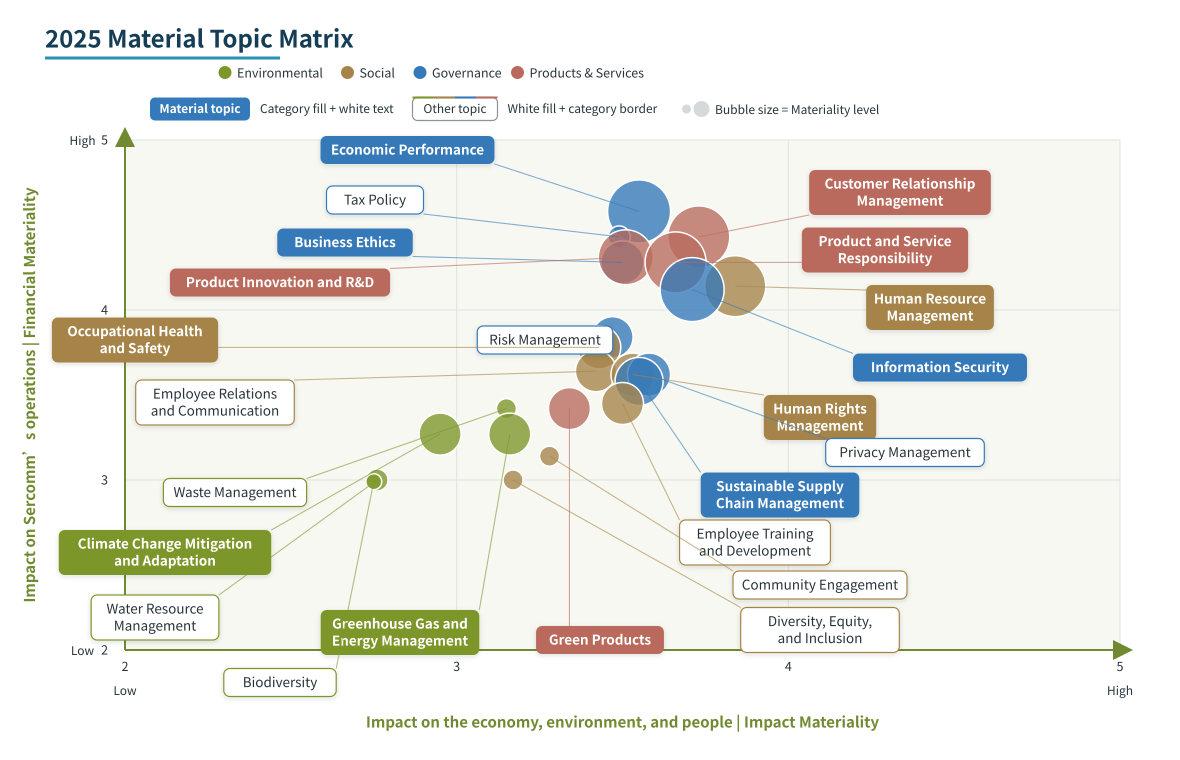
Following the GRI Universal Standards 2021, Sercomm applies double materiality to identify and prioritize sustainability topics. The assessment considers both Sercomm's actual and potential impacts on the economy, environment, and people, including human rights, and the effects of sustainability matters on financial performance, operations, and long-term development. It also supports preparations for IFRS S1 and S2.
Double Materiality
Impact materiality: Actual or potential positive and negative impacts on the economy, environment, and people, considering severity and likelihood.
Financial materiality: Potential effects of sustainability matters on Sercomm's financial performance, operations, and long-term development.
2025 Assessment Process
01 Understand the context: Starting with 23 topics, Sercomm collected 30 internal questionnaires to identify five stakeholder groups and 70 stakeholder concern surveys.
02 Identify impacts: The Company analyzed 23 positive and 23 negative impact factors.
03 Assess significance: Nineteen impact surveys and seven financial materiality surveys were collected.
04 Prioritize reporting: Topics were ranked by stakeholder views, impact significance, strategic relevance, and financial materiality. The Sustainable Development Committee approved 13 material topics.
2025 Material Topics
Environmental: Climate Change Mitigation and Adaptation; Greenhouse Gas and Energy Management.
Social: Human Resource Management; Occupational Health and Safety; Human Rights Management.
Governance: Economic Performance; Information Security; Sustainable Supply Chain Management; Business Ethics.
Products and Services: Product Innovation and R&D; Customer Relationship Management; Product and Service Responsibility; Green Products.
Reading the Matrix and Governance
The horizontal axis shows impacts on the economy, environment, and people; the vertical axis shows financial materiality. Bubble size indicates the materiality level, while filled labels identify the 2025 material topics.
Following Committee approval, the results are incorporated into the annual Sustainability Report and submitted to the Board for approval before publication. See pages 22-26 of the 2025 Sustainability Report for the full methodology, impact descriptions, matrix, and ranking.
Sercomm manages business ethics through policies, Board oversight, risk assessment, preventive controls, and internal audit. The framework covers directors, managers, employees, and supplier partners through applicable rules and commitments.
Policies and Scope
Key policies include the Ethical Corporate Management Best Practice Principles, Procedures for Ethical Management and Guidelines for Conduct, the Code of Ethical Conduct for Directors and Managers, and insider trading controls. They prohibit bribery, improper donations, illegal political contributions, conflicts of interest, unfair trade, and other improper benefits. Supplier commitments extend these requirements to business partners.
Governance and Board Oversight
The Internal Audit Office, reporting to the Board, oversees implementation. Management and relevant units perform internal control self-assessments, while Internal Audit reviews integrity risks, establishes checks for high-risk matters, and reports implementation to the Board annually.
Risk Assessment and Prevention
Annual assessments consider revenue, procurement, production capacity, and prior high-risk audit findings. Controls include Code of Ethical Conduct acknowledgment, mandatory training, onboarding communication, and insider trading reminders.
Internal Audit and Follow-up
The annual audit plan is approved by the Board. Audit progress and corrective actions are reported quarterly to the Audit Committee and the Board, with continued follow-up on key locations and high-risk processes.
2025 Performance
- Integrity risk assessments covered the headquarters and major manufacturing centers in Chunan, Suzhou, and the Philippines, achieving 100% coverage.
- All new employees signed the Code of Ethical Conduct. Business ethics training totaled 199.26 man-hours and 5,091 attendances, with a 71.93% implementation rate.
- All 94 internal audit findings were corrected.
- No corruption involving Sercomm or internal personnel was identified. One outsourced security worker in Suzhou falsified attendance records. The worker was blacklisted, the service provider was fined and not renewed, relevant managers were disciplined, and controls were strengthened.